



South Texas is oilfield country, and the question of whether to rent or buy equipment comes up constantly for operators scaling up, contractors adding capacity, and crews managing project-specific needs. The math is not always obvious. Owning feels like it builds equity. Renting feels like spending without an asset to show for it. Neither framing is quite right. Here is what the decision actually comes down to.
AOS Rental maintains a full inventory of oilfield equipment for South Texas operators, including pumps, flare systems, pressure washers, and more.
The Case for Renting Oilfield Equipment
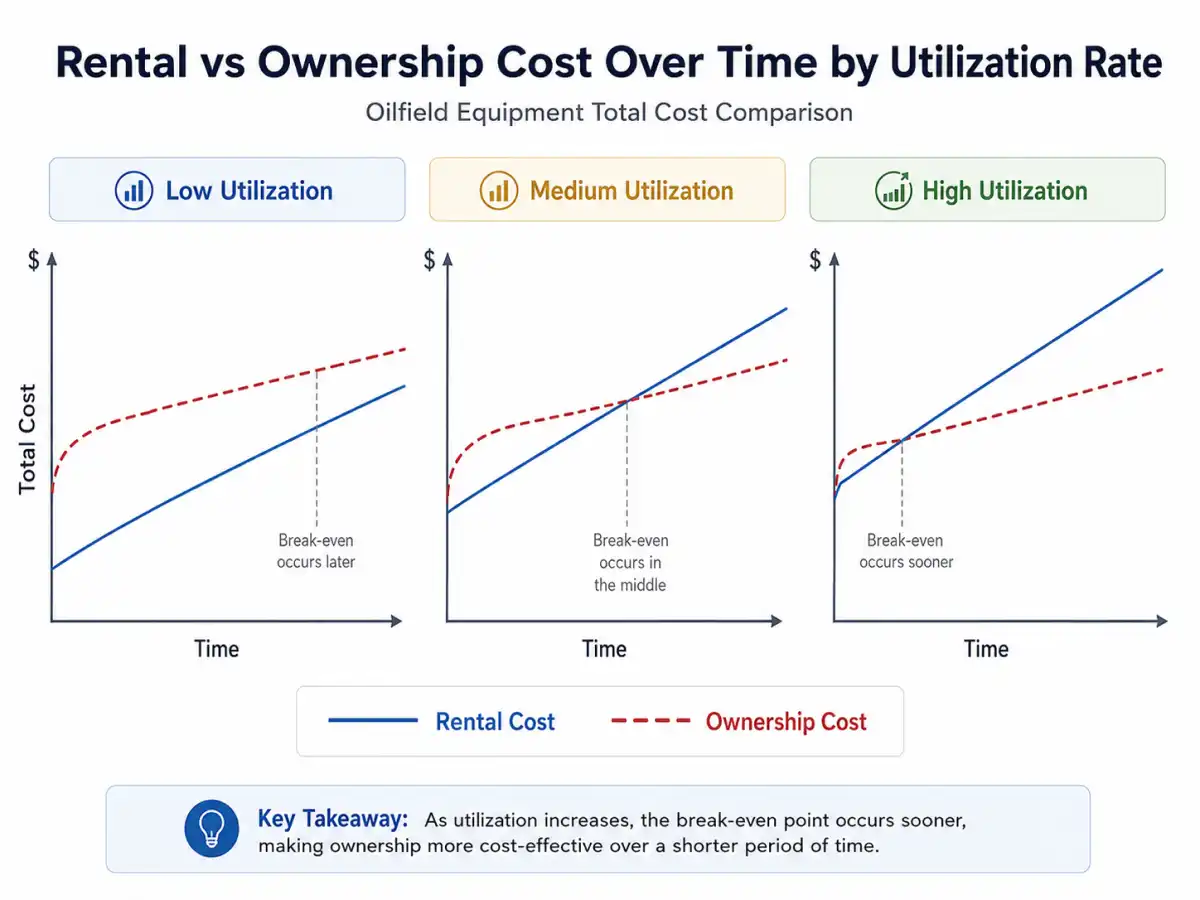
Utilization rate is the number that matters most. If you cannot keep a piece of equipment working 60-70% of scheduled work days, rental almost always wins on total cost. Owned equipment that sits generates no revenue but continues to depreciate, require maintenance, need storage, and carry insurance costs. The break-even math on ownership requires sustained utilization to work.
Project-specific needs are a natural fit for rental. If you need a particular machine for one job or one phase of a project, buying to cover that need rarely pencils out. You end up with an asset you may not need again for 18 months, and the carrying costs during that gap matter.
Technology evolves on meaningful timescales in heavy equipment. Newer machines offer real improvements in fuel efficiency, emissions compliance, safety systems, and productivity. Rental means you are always working with equipment that has been maintained and updated to current standards. Owned equipment locks you into a specific technology generation for the depreciation cycle.
Maintenance responsibility stays with the rental company. On a rental, mechanical issues get handled by the fleet owner, not your crew, not your budget. For South Texas E&P operators managing tight margins, predictable equipment costs have genuine value in cash flow planning.
Our oilfield pumps and flare systems are available for project-specific rental with flexible terms.
The Case for Buying Oilfield Equipment
High utilization changes the equation significantly. If you run a machine 10-12 hours per day, six days a week, for most of the year, the daily rental rate accumulates quickly. At sustained high utilization, the total cost of ownership over 5-7 years, including purchase price, financing costs, maintenance, insurance, and residual value, can be meaningfully lower than equivalent rental costs over the same period. The key word is sustained.
Specific customization sometimes requires ownership. Certain oilfield applications need specialized attachments, rigging configurations, or modifications that rental units will not carry. If your operation requires a machine configured exactly one way and kept that way between jobs, ownership makes practical sense that goes beyond the financial comparison.
Fleet consistency matters to some operations. Owned equipment enables standardized operator training, consistent performance expectations, and integrated maintenance tracking across your fleet. For companies with large crews and strict safety protocols, the consistency of known equipment has operational value beyond pure cost comparison.
The Three Questions That Should Drive Your Decision
First: How many days per year will this machine actually work? Under 150 productive days annually, rental is almost always the better financial choice. Over 200 days, run the ownership numbers. The math may favor buying. The 150-200 day range is genuinely ambiguous and depends on machine cost, your financing rate, and your maintenance capacity.
Second: Is this need long-term or project-specific? A sustained multi-year operational need in your core business is a fundamentally different situation from a project-based requirement. Buying for the former makes sense. Buying for the latter usually does not.
Third: What is your cash position and capital flexibility? Ownership requires capital, either purchase price or financing payments plus a maintenance reserve. Rental requires operating budget but no capital commitment. In the volatile commodity price environment of South Texas E&P, maintaining capital flexibility sometimes outweighs the theoretical long-run savings of ownership. When oil prices drop and activity slows, rented equipment goes back to the yard. Owned equipment becomes a liability on the books.
Working with AOS Rental for South Texas Oilfield Equipment Needs
AOS Rental maintains a fleet of equipment for South Texas oilfield and industrial operators. We understand the project-based nature of E&P work and the utilization reality of South Texas field operations. Rental agreements can be structured to give you operational flexibility without long-term capital commitment, the right approach when your work volume varies with commodity prices and project pipelines.
View our full oilfield equipment inventory or visit our services page to learn more about how we support South Texas operators.
Contact AOS Rental to discuss your equipment needs and get a rental quote matched to your project timeline and specification.
Frequently Asked Questions
Is it better to rent or buy oilfield equipment in South Texas?
It depends on utilization rate. Under 150 productive days per year, rental typically wins financially. Over 200 days at sustained use, ownership may pencil out. Cash flow flexibility often favors rental in the volatile E&P environment.
What are the main advantages of renting oilfield equipment?
No capital commitment, predictable costs, no maintenance liability, access to current technology, and the ability to scale fleet up or down with project demand.
When does buying heavy equipment make more financial sense than renting?
When you can sustain utilization above 200 days per year, require specific customization, need fleet consistency for safety programs, or when long-run total cost of ownership is clearly lower than equivalent rental costs.